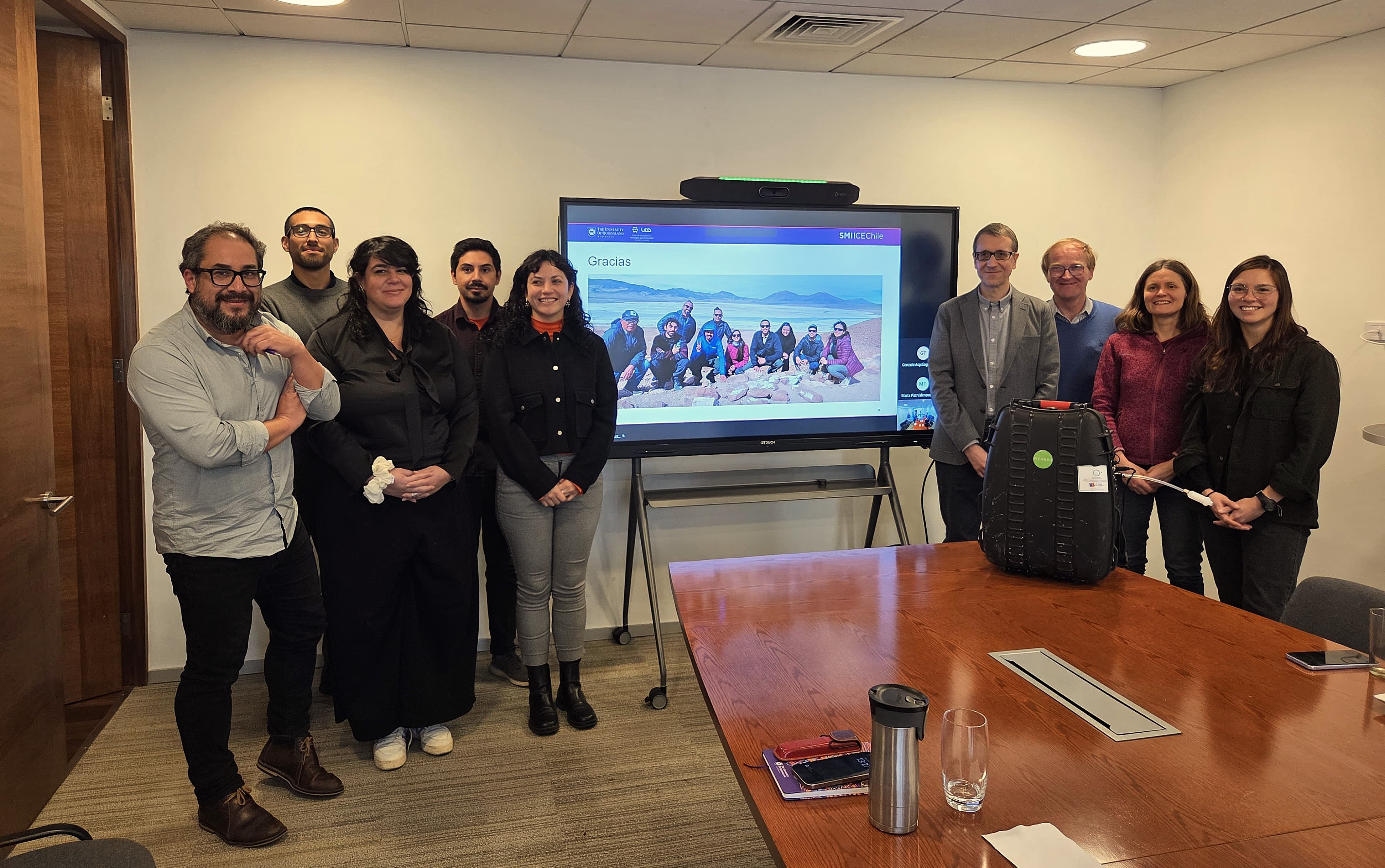
The Environmental Rehabilitation and Ecosystem Dynamics teams from SMI-ICE-Chile and the C+ team at the Universidad del Desarrollo (UDD) held an internal seminar to present the preliminary results of the first field monitoring campaign, conducted as part of the project «Estimation of the Net Balance of Greenhouse Gas Emissions from the Lagunillas Wetland and Carbon Offset Proposal,» which is being carried out for a mining company.
In this event for scientific exchange and dissemination, María Paz Valenzuela, Pablo Bustos, and Nicolás Orellana spoke on behalf of SMI-ICE-Chile, and Macarena Troncoso, representing C+, also participated. Also participating in this event were Dr. Jacques Wiertz, Dr. David Rubinos, Daniela Gamboa from SMI-ICE-Chile, and Camilo Rodríguez, director of C+.
María Paz Valenzuela, Macarena Troncoso, Pablo Bustos, and Nicolás Orellana presented the various technical aspects and scope of this first field campaign, which was validated by the Aymara indigenous community of Cancosa and participated in by its environmental monitors. During the six days of field visits, soil and sediment samples were taken, and plant ecophysiological variables were monitored. The objective was to measure the greenhouse gas fluxes of carbon dioxide (CO2) and methane (CH4), and water vapor (H2O) in the bofedal.
Located in the high Andean region of Tarapacá, the Lagunillas wetland is a highly significant ecosystem due to its biodiversity and unique capacity to capture and store carbon, a key factor in climate regulation. Carbon loss in these ecosystems not only accelerates climate change but also has serious repercussions for ecosystem health and human well-being.
The Lagunillas wetlands provide various ecosystem services to the indigenous communities of Lirima, Collacagua, and Cancosa, mostly Aymara, who make ancestral use of this area and subsist primarily on agricultural and livestock activities. However, the high demand for groundwater in high Andean wetlands has affected the structure and conservation of these ecosystems, impacting the provision of services essential for human well-being and local economic development.
This project also proposes generating a long-term conservation plan that anticipates the effects of climate change and potential alterations in the net balance of greenhouse gas emissions, as well as changes in carbon capture and emission rates.
This project, led by SMI-ICE Chile, has a team that also includes researchers from the University of Queensland, the University of Concepción, and the Universidad del Desarrollo.
Watch the animated video