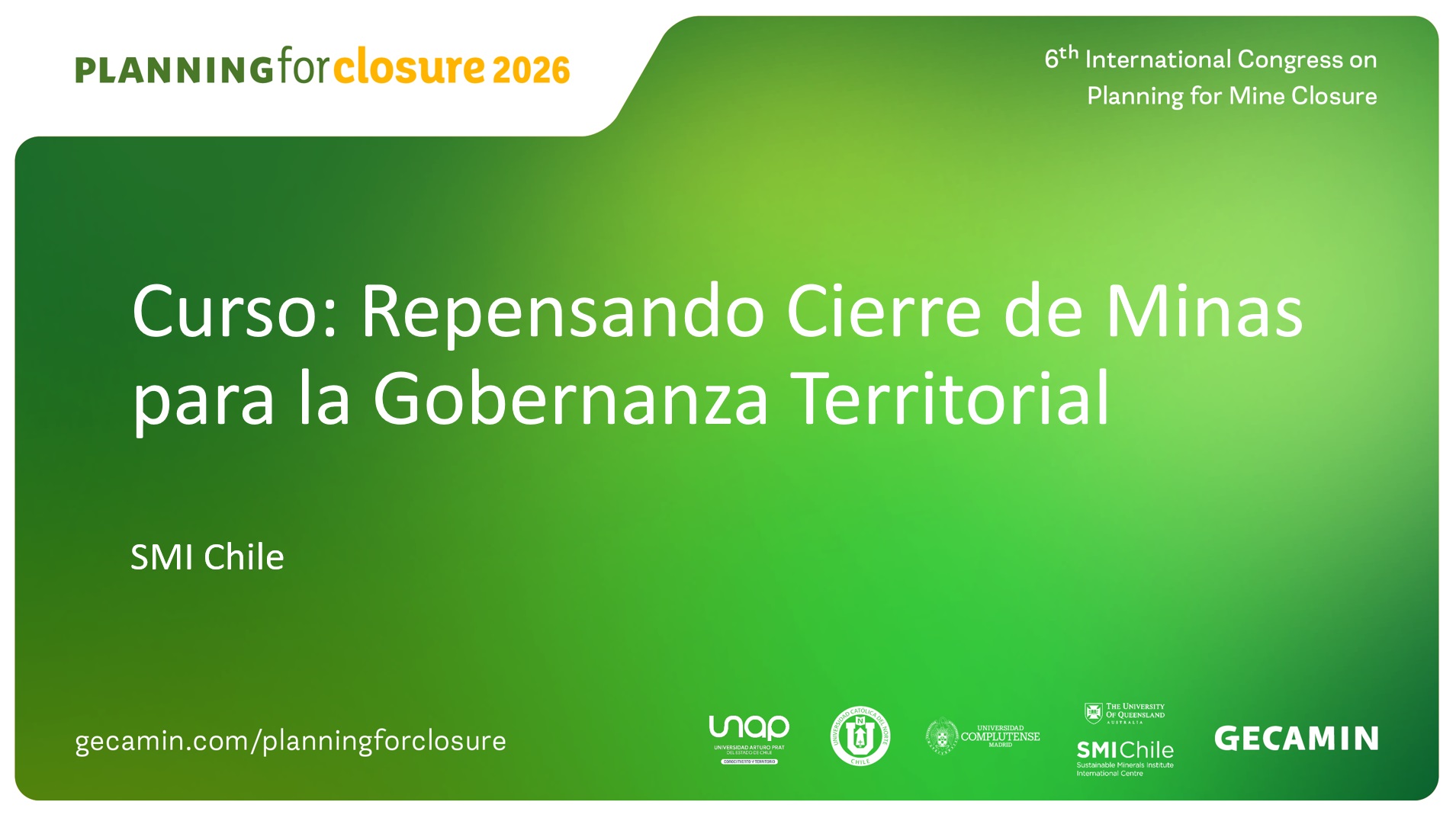
With strong attendance, a multidisciplinary team from SMI Chile launched its participation in the leading mine closure conference by presenting an approach that calls for rethinking mine closure as a long-term territorial governance challenge.
“Rethinking Mine Closure for Territorial Governance” was the title of the technical course delivered by Nigel Wight, Jacques Wiertz, Daniela Gamboa and Bárbara Stubing as part of Mining for Closure 2026. The session attracted 110 participants.
The course explored how environmental, social and productive dimensions of a territory can be integrated into mine closure planning, while also incorporating stakeholder perspectives and the pursuit of positive post-mining legacies.
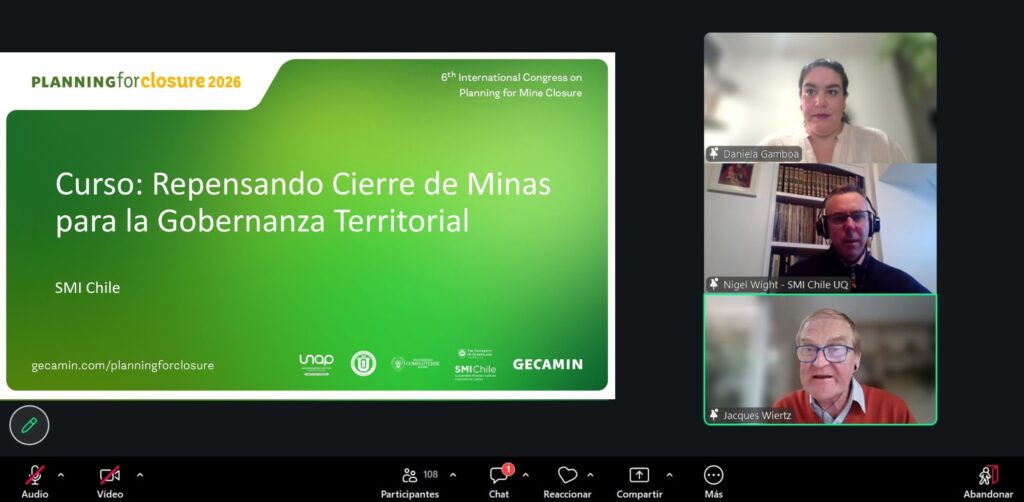
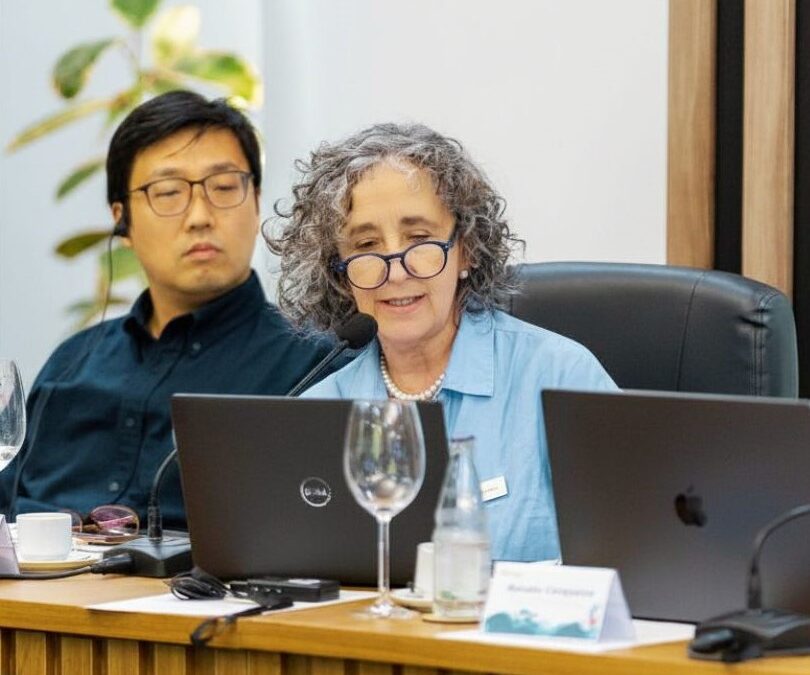
Daniela Gamboa, Nigel Wight y Jacques Wiertz presentan en Planning for Closure 2026
Globally, it is estimated that around 40 per cent of mining operations belonging to the International Council on Mining and Metals (ICMM) will close over the next 20 years.
“Today, the mining industry faces two key challenges in relation to closure: preventing environmental impacts from becoming permanent liabilities and creating positive legacies that endure beyond the life of the operation,” said Nigel Wight.
The course reviewed international standards and frameworks that guide integrated mine closure, including ICMM guidance, recommendations from ECLAC and Mining 2030, as well as reference frameworks such as GRI and IRMA.
In Chile, one of the most widely used benchmarks is The Copper Mark, which promotes long-term environmental, economic and social stability through management, monitoring and financial systems for closure and post-closure activities.
According to Daniela Gamboa, researcher with SMI Chile’s Environmental Rehabilitation and Ecosystem Dynamics team, one of the main obstacles is that mine closure continues to be treated primarily as a technical and regulatory compliance exercise.
In her view, this approach is insufficient because mining’s territorial footprint extends well beyond the immediate operational area. Closure can trigger economic, social and ecological transformations at a regional scale that are difficult to address through fragmented assessments.
Gamboa noted that this conventional approach to closure has historically focused on regulatory compliance and the physical and chemical stabilisation of mine sites, favouring short-term technical solutions that make it difficult to understand long-term interactions between ecosystems, communities and productive activities.
Another weakness of this traditional perspective, she said, is the limited early involvement of territorial stakeholders in closure planning.
“Local communities are often engaged only during late-stage consultation processes, leaving little opportunity to build shared agreements about future land use, which can ultimately undermine the social legitimacy of the measures implemented,” she said.
Gamboa also argued that the mining sector has tended to underestimate closure costs, compromising the long-term sustainability of restoration efforts.
Citing Mining 2030, she noted that more than 90 per cent of projects reach closure with insufficient funding, a gap linked to financial models that have historically failed to fully account for closure costs.
“For restoration to be sustainable,” she said, “it requires not only environmental recovery, but also adaptive capacity and meaningful community participation in the post-mining transition.”
She added that regulatory gaps remain. “Although Chile has a mine closure law, it still lacks comprehensive land-use regulations and specific legislation addressing environmental liabilities that would enable truly integrated planning.”
In response, the broader closure perspective presented during the course proposes understanding territory as an interconnected socio-ecological system, where communities, ecosystems, culture, natural resources and productive activities are linked through relationships of mutual dependence.
From this perspective, closure planning must extend beyond the operational life of a mine, incorporating future scenarios and restoration approaches that go beyond stabilising waste deposits or revegetating disturbed land. Instead, it should place nature’s contributions and ecosystem wellbeing at the centre of efforts to sustain livelihoods and essential services for communities.
A successful mine closure therefore requires territorial governance and participatory planning, including the collective definition of objectives for the post-mining landscape.
Within this framework, mine closure can become an opportunity to promote territorial sustainability and support a just transition that balances human wellbeing with ecosystem conservation.
Nigel Wight emphasised that mine closure legacies are often associated with negative concepts such as acid mine drainage, abandonment, contamination, waste, tailings and ghost towns.
“However,” he explained, “the industry is moving away from an approach focused solely on liabilities towards an integrated and sustainable closure model that adopts a life-cycle perspective and prioritises the creation of positive legacies.”
As an example, Jacques Wiertz, leader of SMI Chile’s Responsible Production and Ecosystem Dynamics team, highlighted the Blair Athol mine in Australia, where closure activities included eucalyptus reforestation, restoration of ecological corridors and the creation of conditions that enabled koalas to return to rehabilitated areas.
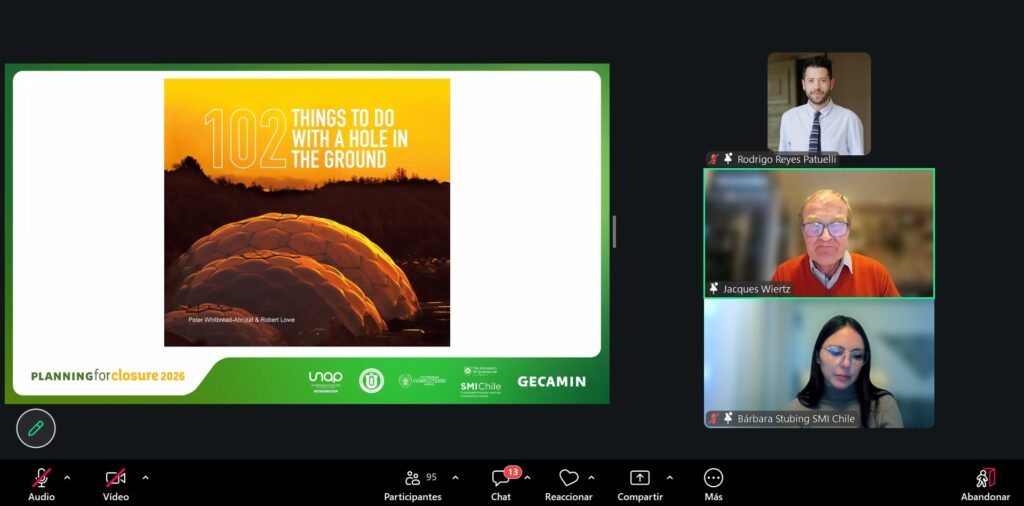
“The Eden Project in Cornwall, south-west England, is another emblematic closure example,” Wiertz added.
“It transformed a depleted clay mine into a major centre for environmental restoration, education and sustainable tourism. Opened in 2001, the project rehabilitated a vast mining crater through the creation of ecological landscapes and two large geodesic biomes that recreate tropical and Mediterranean ecosystems, housing thousands of plant species. Beyond the physical rehabilitation of the site, the Eden Project demonstrated how an abandoned mining area could be transformed into a driver of economic development, environmental education and regional regeneration.”

Concluding the session, Wiertz highlighted several principles that should guide closure philosophy.
“It is important to understand that, due to the principle of irreversibility, or entropy, it is impossible to return a site to its exact pre-project condition. Moreover, pursuing a state that merely resembles the original is not always feasible or desirable,” he said.
“Future land use should not be a projection of the mining company’s vision, but rather a co-created project developed with local communities, recognising that it may evolve and adapt in response to changing circumstances and the aspirations of territorial stakeholders.”