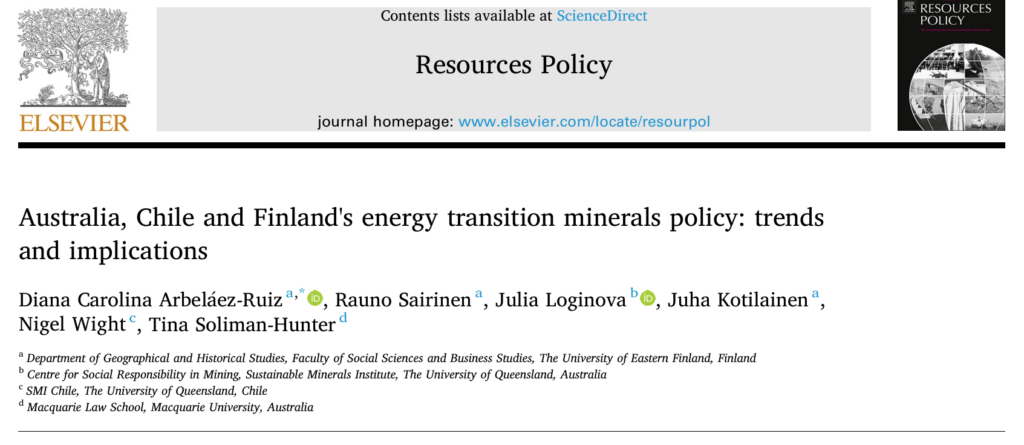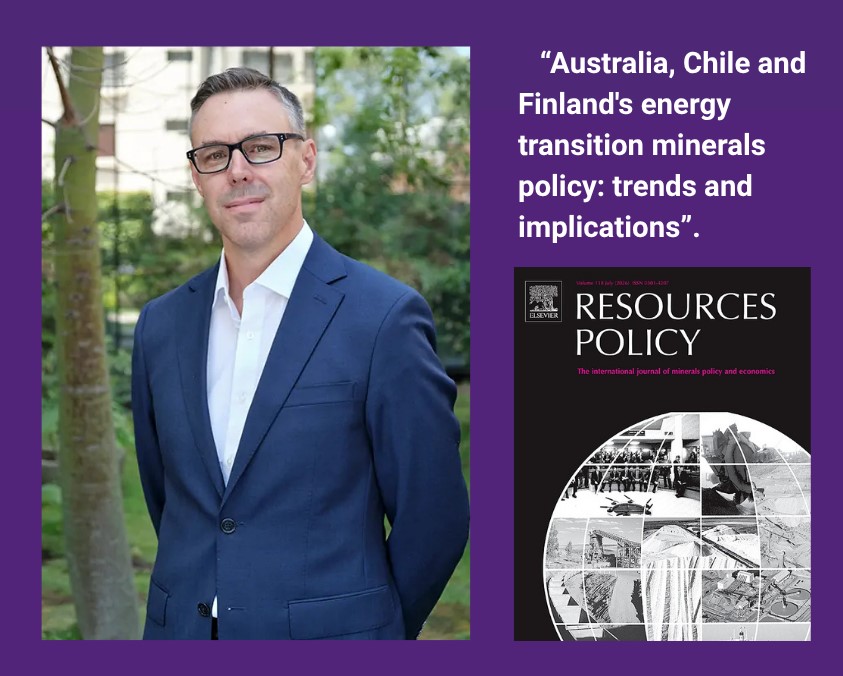
Together with five international researchers, SMI Chile researcher Dr Nigel Wight has published a scientific paper that makes an important contribution to the global energy transition debate. Entitled “Energy Transition Minerals Policy in Australia, Chile and Finland: Trends and Implications”, the study appears in the latest issue of Resources Policy.
In addition to Dr Nigel Wight, the paper was co-authored by Diana Carolina Arbelaez-Ruiz, Rauno Sairinen, Julia Loginova, Juha Kotilainen and Tina Soliman-Hunter.
The study provides a comparative review of energy transition mineral policies in Australia, Chile and Finland, examining how governments have responded to the growing demand for critical minerals required for renewable energy technologies. It analyses the policy frameworks developed to strengthen critical mineral value chains by increasing economic returns, building domestic capabilities, generating greater value-added opportunities and reinforcing international partnerships. The paper also explores how these countries are addressing the environmental, social and governance challenges, as well as the legacy issues and cumulative impacts associated with industrial expansion.
“In Australia and Chile,” the authors note, “the historical prominence of the mining industry has shaped influential mining-focused policy communities, whereas Finland’s policy community has adopted a broader industrial ecosystems approach.” The paper also highlights the role of critical engagement policy networks in broadening policy agendas to include social and environmental governance and Indigenous rights through policy innovation. Examples include Chile’s concept of industrial and environmental knowledge as a public good and Finland’s strengthened municipal powers.
“If fully implemented – including through mechanisms such as Indigenous Free, Prior and Informed Consent (FPIC) – the policy innovations advanced by these critical engagement policy networks have the potential to help balance industrial growth with social and environmental priorities.”
The paper further explains that these critical engagement policy networks strengthen social and environmental governance and promote Indigenous rights, particularly in contexts of conflict, historical legacies or industrial disasters. Mechanisms such as Chile’s environmental tribunals and Finland’s Citizens’ Petitions and enhanced municipal powers enable Indigenous Peoples, host communities and environmental NGOs to advocate for appropriate checks and balances during industrial expansion.
The authors also identify promising policy innovations emerging from Chile. “Some of Chile’s proposed policy measures show significant potential to balance industrial growth with social and environmental priorities,” they conclude. “These include the proposed expansion of environmental conservation areas in the salars, and the innovative concept of ‘knowledge as a public good’ through state participation in the lithium sector.”
Check out the article at the following link
https://www.sciencedirect.com/science/article/pii/S030142072600139X