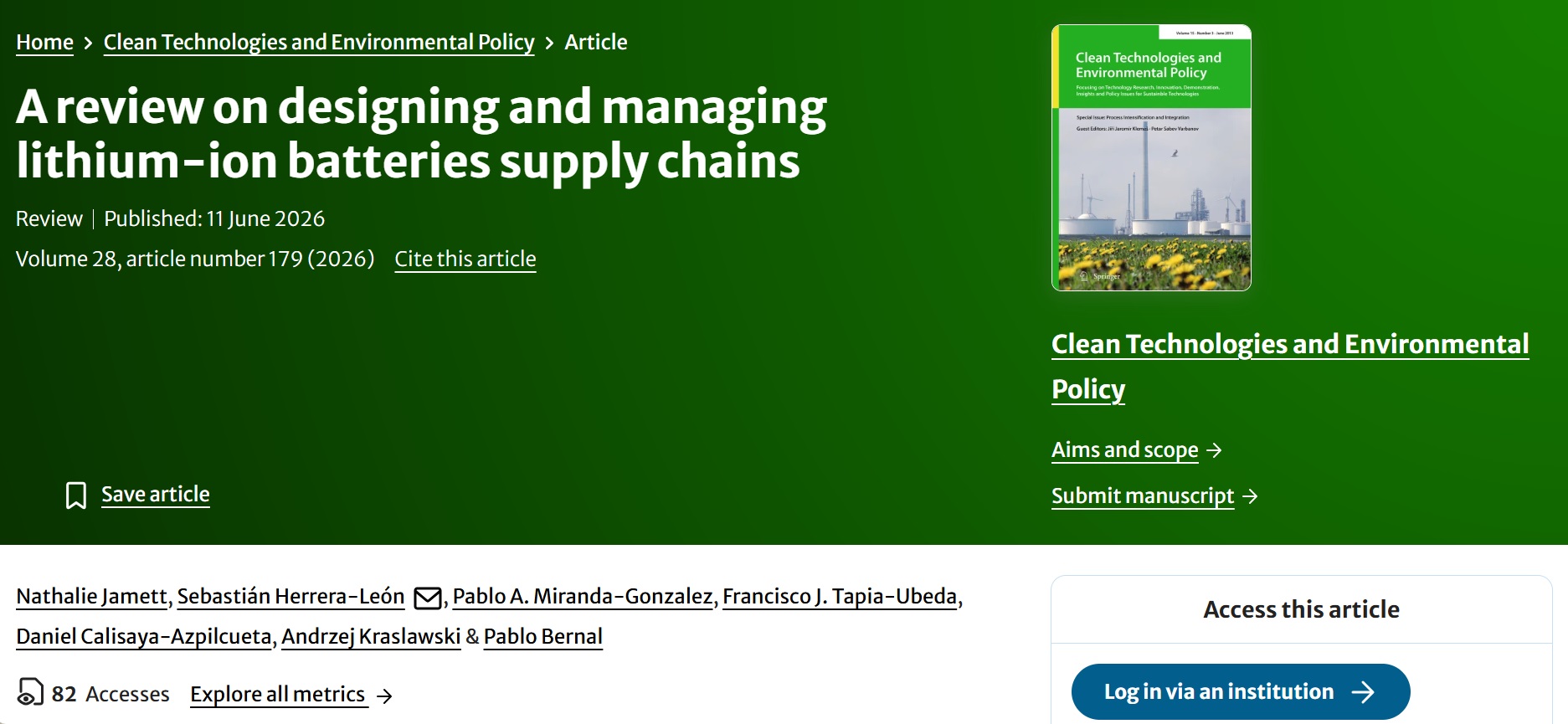
The SMI Chile researcher is part of a team of seven academics from different universities who have published a study on the challenges facing the supply chain of this strategic mineral for the global energy transition in the journal Clean Technologies and Environmental Policy.
The paper, entitled “A Review on Designing and Managing Lithium-Ion Batteries Supply Chains”, was authored by Nathalie Jamett, Sebastián Herrera-León (Universidad de O’Higgins), Pablo A. Miranda-Gonzalez (Universidad Católica del Norte), Francisco J. Tapia-Ubeda (Universidad Católica del Norte), Daniel Calisaya-Azpilcueta (Universidad Católica del Norte), Andrzej Kraslawski (LUT University), and Pablo Bernal (LUT University).
The study addresses a highly relevant issue: the challenge posed by the rapidly growing demand for lithium-ion batteries driven by the transition from fossil fuels to cleaner energy sources.
The article highlights the urgent need for further research into the design and management of supply chains that incorporate both the manufacturing and recycling stages of lithium-ion batteries. Particular attention is given to the location and establishment of appropriate facilities, the design and implementation of associated processes, and transport-related decision-making.
The transition towards cleaner energy sources and technologies, the authors explain, has generated increasing interest in the manufacturing and recycling of these batteries, drawing attention to the methodologies, technologies and regulatory frameworks associated with the reuse and second-life applications of lithium-ion batteries (LIBs).
This trend has also stimulated greater interest in understanding and analysing the key managerial aspects of LIB supply chains. Recent studies highlight the emergence of cross-cutting strategies that integrate uncertainty management, digitalisation and policy-driven mechanisms into supply chain design, reflecting a shift from static and deterministic models towards more adaptive and resilient systems capable of responding to dynamic market and regulatory conditions.
However, the paper identifies the need to incorporate sustainability metrics related to environmental and social dimensions in order to provide a comprehensive and sustainable approach to lithium supply chain design and management.
The authors also point to significant research gaps concerning the circularity of lithium battery supply chains, including the complexity of battery composition, the variability of recycling processes, and the introduction of new markets in less-developed countries.
“The integration of multiple objectives — economic, environmental and social — within unified decision-making frameworks remains limited, particularly under conditions of uncertainty and data scarcity,” the authors note. “The incorporation of data analytics, artificial intelligence and other advanced techniques can significantly enhance the management of these aspects within LIB supply chains.”
They add: “Building on these findings, future research should more explicitly connect modelling approaches with real-world industrial challenges. In particular, stochastic and multi-stage optimisation models can support supply chain design under uncertainty, while digital and AI-based tools can strengthen real-time decision-making.
“Furthermore, agent-based and game-theoretic models show strong potential for capturing interactions among stakeholders in recycling systems, while hybrid multi-objective optimisation approaches remain essential for addressing trade-offs between economic, environmental and social objectives.”
Read more about the article at the link below.
A review on designing and managing lithium-ion batteries supply chains