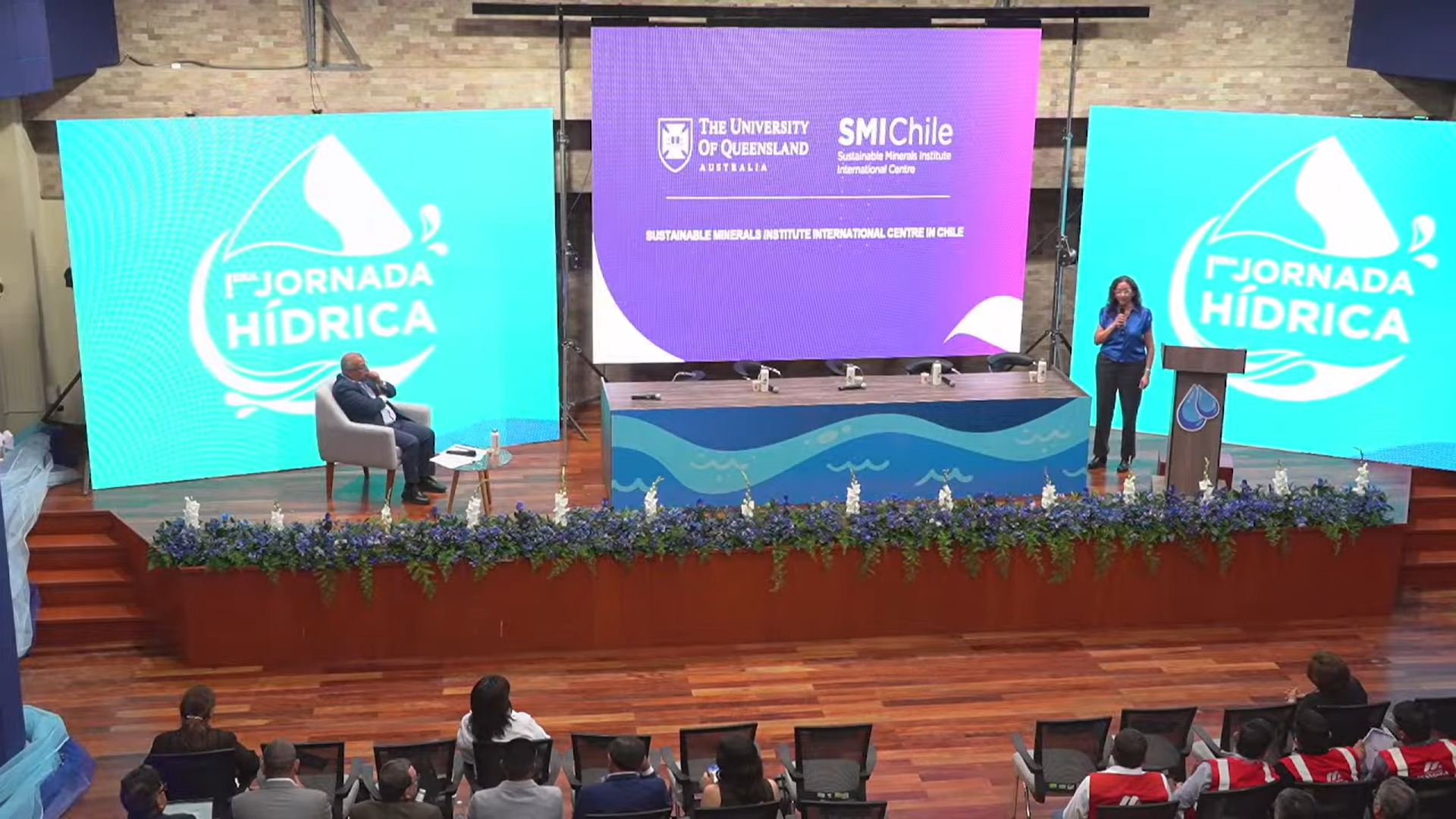
As part of the 1st Moquegua Water Conference, SMI Chile researcher Dr Nathalie Jamett presented the work developed in Chile to advance towards an integrated and collaborative water supply model.
The event, organised by Moquegua Crece, brought together experts, authorities, and representatives from local communities and Peru’s agricultural sector over three days to discuss the main challenges of water management in this department in south-eastern Peru. Moquegua is both an agricultural and mining area, characterised by extreme aridity and a water balance that remains in deficit for much of the year.
Dr Nathalie Jamett, Head of Responsible Production and Mining Process Optimisation at SMI Chile, presented the integrated water management project developed by the Centre with the support of M.C. Inversiones Limitada (a subsidiary of Mitsubishi Corporation in Chile). The initiative aims to provide a platform to advance the concept of integrated water supply systems, optimising the use of the resource to benefit different users, while minimising cost and environmental impact.
Chile ranks 16th among the countries with the highest water stress worldwide, while Peru ranks 32nd. “Water scarcity in central and northern Chile is extremely high and poses significant risk,” explained Nathalie Jamett. “This is not the case in southern Chile, where we see high availability of this resource for different activities, and therefore we observe an unequal distribution of water across the Chilean territory. In Peru, we also see major differences in water availability.”
Projections for water availability in Chile and Peru by 2050 are not encouraging, suggesting that both countries could face water stress levels comparable to those of Middle Eastern countries.
Nathalie Jamett outlined how, since 1960, water use by different industries in Chile has steadily increased. For example, water use in the hydroelectric sector has grown more than fourfold, and in agriculture it has more than doubled. Most significantly, water use has increased in areas affected by severe drought and where many of Chile’s major mining projects operate, such as Antofagasta. “Copper mining uses various sources, including surface and groundwater, as well as seawater, the use of which has grown strongly in recent years,” said Nathalie Jamett. “The mining sector has taken on the challenge of responsible water management, with more than 74% of the water used coming from recirculation, and the remainder from freshwater sources and desalinated water. We have seen the sector’s water supply matrix evolve over the past 15 years, with a sharp increase in desalinated water as a supply source.”
The SMI Chile researcher explained that Chile currently has 24 desalination plants, mostly located in the Antofagasta Region, each with its own infrastructure and dedicated to supplying a specific mining project. “Of all the desalination plants currently in operation,” she said, “only one is multi-purpose, meaning it seeks to supply water to more than one sector. We find this unacceptable, particularly given the severe water scarcity in the Antofagasta area.”
She then described the shift in model proposed by SMI Chile: moving towards shared infrastructure used by different actors across the territory. “This approach operates in other sectors, such as electricity supply in Chile, where different sources connect to a single grid that supplies the entire country,” she explained.
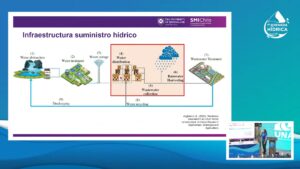
She also presented the example of Australia’s SEQ Water Grid, a large-scale bulk water supply network that primarily serves South East Queensland. It is composed of twelve dams, 31 conventional water treatment plants, three advanced water treatment plants, one desalination plant, 33 bulk water reservoirs, 22 pumping stations, and more than 600 km of bulk water supply pipelines. “It is a solution that provides drinking water to nearly 53,000 people living in 16 communities outside the main grid.”
“Moving towards a collaborative and territorial model, beyond the logic of isolated projects, brings economic, social and environmental benefits aligned with sustainability and the water transition,” she explained. “This type of shared infrastructure also supports the building of trust and the strengthening of mining’s reputation.”
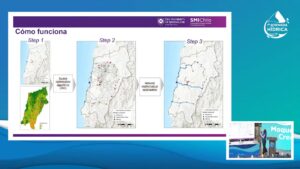
As part of this project, SMI Chile developed software that integrates the different water-demand actors, the spatial characteristics of the territory, and the costs of pumping water from one location to another under these conditions. It also incorporates environmental considerations, taking into account protected areas, as well as the social costs and opportunities within a given territory. The software is capable of identifying the most effective way to distribute water resources based on all of these criteria. “This makes it possible to design distribution networks under different territorial scenarios,” she explained.
Finally, she stressed that shared water infrastructure is not only a technical solution, but also a governance tool, and therefore requires clear regulatory frameworks and robust planning instruments.
The 1st Moquegua Water Conference lasted three days. On the first day, prior to the start of presentations at the National University of Moquegua, participants visited the field alongside local farming communities, as well as the Pasto Grande project.
“It was an initiative highly valued by the local agricultural sector,” said Nathalie Jamett. “Territorial stakeholders expressed that they felt heard and taken into account, which reinforces the importance of these participatory spaces.”
Check out Nathalie Jamett’s full presentation at this YouTube link (minute 2:52:11)