The General Manager and Acting Executive Director of SMI Chile was one of the panellists at the event organised by the Faculty of Engineering at the Universidad del Desarrollo, which addressed the challenges and opportunities facing the mining sector in relation to women.
The seminar, titled “Women and Mining: Challenges and Opportunities in the Industry of the Future”, brought together leading authorities, academics and representatives from the mining industry, including the Rector of the Universidad del Desarrollo, Federico Valdés; the Dean of the Faculty of Engineering, Fernando Rojas; and the Undersecretary of the Ministry of Women and Gender Equality, Daniela Castro.
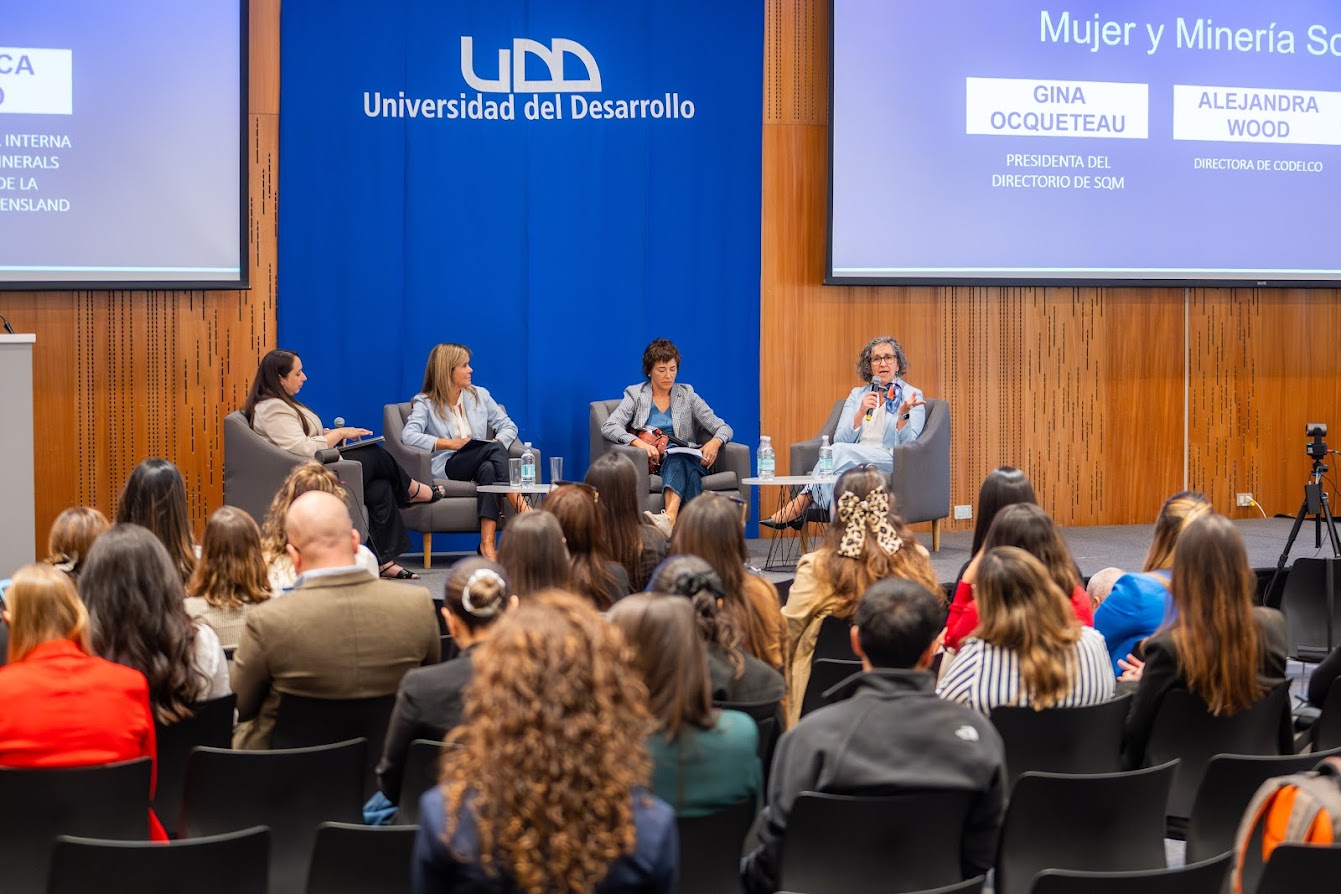
Representing SMI Chile, Francisca Rivero took part in the panel “Women and Sustainable Mining”, moderated by América Rodríguez, Editor-in-Chief of Reporte Minero. She was joined by Gina Ocqueteau, Chair of the Board at SMQ, and Alejandra Wood, Board Member at Codelco.
When asked about the usefulness of ESG (Environmental, Social and Governance) criteria, Francisca Rivero argued that the complexity of the mining industry requires moving well beyond these standards. “In Chile and across Latin America, mining still faces a major challenge in defining how it aims to create impact in social, environmental and governance terms. In the context of the National Lithium Strategy, for example, it is essential to establish territorial governance, as our critical minerals are located in highly strategic areas that require clear approaches to integrating mining with governance systems that generate value for the territory, not only for operating companies. We need governance models that define how wealth is distributed in mining regions—an issue that some companies are already addressing with increasing rigour.”
Gina Ocqueteau also emphasised the importance of working closely with communities in the territories where mining operates in order to build balanced and trust-based relationships. “Companies need to be coherent and consistent in what they communicate and what they do, as stakeholders are constantly scrutinising our actions,” she explained. “We need that feedback from communities to ensure that improvements are meaningful (…) Beyond the pursuit of a social licence to operate, it is essential to genuinely listen to communities. Leadership means listening. When Indigenous communities raise their voices, it is a call for us to do things properly. Mining companies are publicly listed and subject to high standards, and rightly so. We are at a point where there can be no step backwards, as expectations will only continue to rise. Measuring sustainability indicators, with a clear, rigorous and comprehensive roadmap, is therefore a positive development that the Chilean mining industry is increasingly embracing.”
Regarding the way the industry is approaching sustainability, Alejandra Wood noted that it is no longer limited to compliance or reputation management, but has become a strategic enabler of the business. “Sustainability is structurally transforming the way mining is carried out,” she said. “Companies now understand that without a social licence to operate, sound water management and mature relationships with the territories in which they operate, there can be no operational continuity or access to capital. We are moving from a more defensive, compliance-driven approach to a more strategic one. Chile stands on the brink of a new mining boom, but the only way this growth can translate into development is through innovation and productivity—both of which must be sustainable for local territories. If we can integrate sustainability with innovation and productivity, we have the opportunity for this new mining cycle to deliver a profound impact on the country’s development.”
She also highlighted that expectations in mining regions have significantly increased. “It is no longer enough to provide jobs or local investment; communities expect early and meaningful participation in projects. It is not just about receiving information, but about being involved in certain decision-making processes. Communities are quick to detect inconsistencies between what is said and what is done, and the only way to build long-term trust is through consistency. The concept of shared value—of participating as a key actor in a common vision—is fundamental.
“For example,” she added, “Chile’s Atacama Region, which is expected to play a central role in the next mining boom, currently lacks the electrical, water and air infrastructure required to support this growth. If the industry does not begin engaging with local stakeholders from the outset, this boom may fail to deliver the territorial impact that is needed, and we risk repeating the challenges seen in cities such as Antofagasta and Calama.”
Watch the full seminar on YouTube