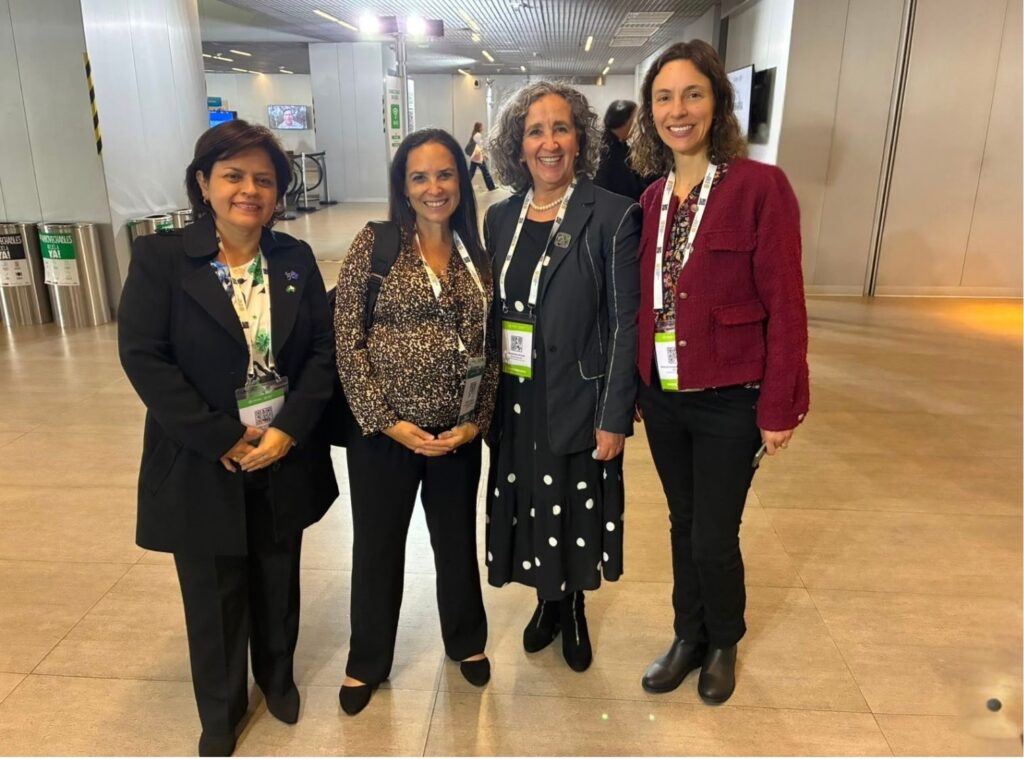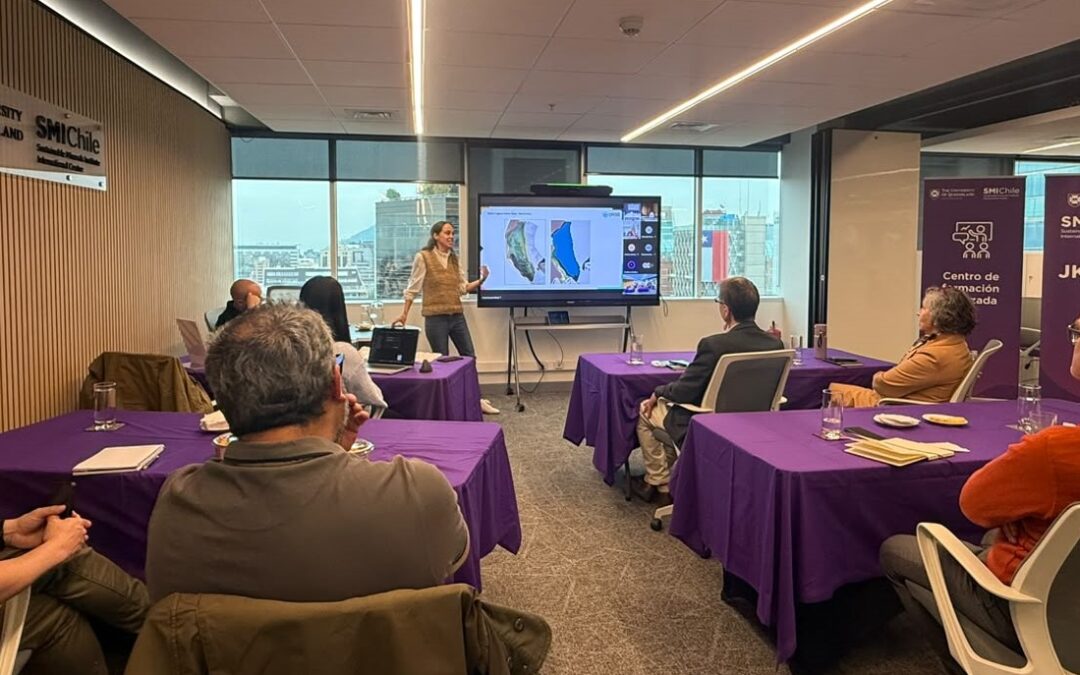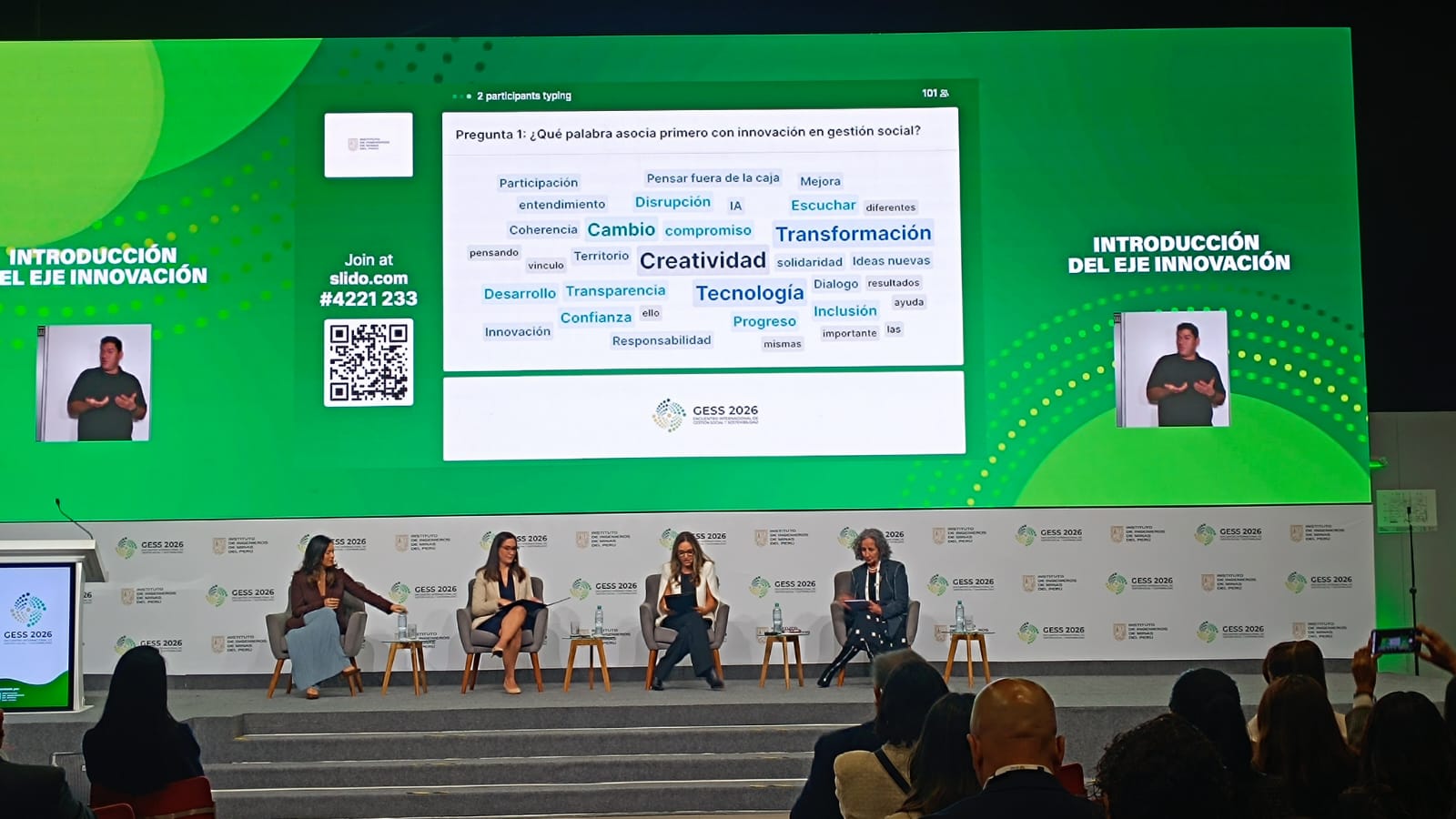
SMI Chile General Manager and Social Performance and Resource Governance researcher Francisca Rivero, together with Mónica Morales, who leads this area at the Centre, are representing SMI Chile at GESS 2026, the International Social Performance and Sustainability Forum, taking place in Lima, Peru.
Organised by the Peruvian Institute of Mining Engineers, the event was opened by senior government officials and representatives from various economic and institutional sectors in the neighbouring country, including Minister of Economy and Finance Elmer Cuba and Minister of Energy and Mines Guillermo Shinno.
The international forum brings together professionals from different sectors who lead projects and programmes with a social focus, providing a space to discuss key challenges related to social innovation, trust and sustainability.
Francisca Rivero was invited to participate in the plenary session “Rethinking Social Performance”, where she shared the discussion with Mariel Rentería, CEO of Paxion, a global innovation and technology platform for critical minerals. The session was facilitated by Carla Toledo, Senior Operations Specialist at the International Finance Corporation (IFC), and Analía Calmell del Solar, Corporate Affairs and Sustainability Manager at electricity generation company Celepsa.
The discussion focused on the factors that shape social innovation and how it can contribute to social performance approaches that recognise the challenges of coordination and collaboration among the different stakeholders present in a territory, with an emphasis on how to enable decision-making that builds trust and generates value at the territorial level.
“Innovation in social performance in mining is not about incorporating more technology,” emphasised Francisca Rivero. “Mining is undergoing an enormous technological transformation, with automation, artificial intelligence, sensors, predictive models and remote monitoring. However, there is a risk of assuming that having more data means we understand territories better. A territory is not simply a set of variables on a dashboard. A territory is history, power relations, identities, expectations, conflicts and different perceptions of the future.”
The General Manager of SMI Chile spoke about the need to develop social intelligence before artificial intelligence, referring to innovations that can be deeply transformative and may begin with a shift in emphasis or changes to a process—for example, when a company incorporates the social dimension into the early stages of project design.
“A company innovates when it moves from informing communities to making decisions with them,” she said. “A territory that establishes a permanent mechanism for coordination between companies, municipalities, communities and academia is also innovating.”
Francisca argued that, rather than seeking a “social licence to operate”, companies should work towards building legitimacy based on trust, where a culture of collaboration and active listening helps overcome fragmentation.
Collaboration was one of the central themes highlighted by all the participants as a decisive factor in driving innovation.
“The main challenge for social innovation in mining is to change our unit of analysis,” she continued. “For a long time, this was the project, with its impacts, mitigation measures, social programmes and stakeholder relationships. Today, our unit of analysis needs to be the territory, because the major challenges we face—water, climate change, biodiversity, local employment, critical minerals, the energy transition and mine closure—cannot be solved by an individual company acting alone.”
Francisca Rivero stressed that there is now a need for shared information, new forms of governance and the ability to build decisions collectively among stakeholders with different interests, knowledge and expectations.
“That is where true social innovation lies: not necessarily in a new technology or a new programme, but in our ability to develop new forms of collaboration.”
“Mining must move from asking how to better manage impacts to asking how, together with others, we can build territories capable of thriving during mining and beyond.”
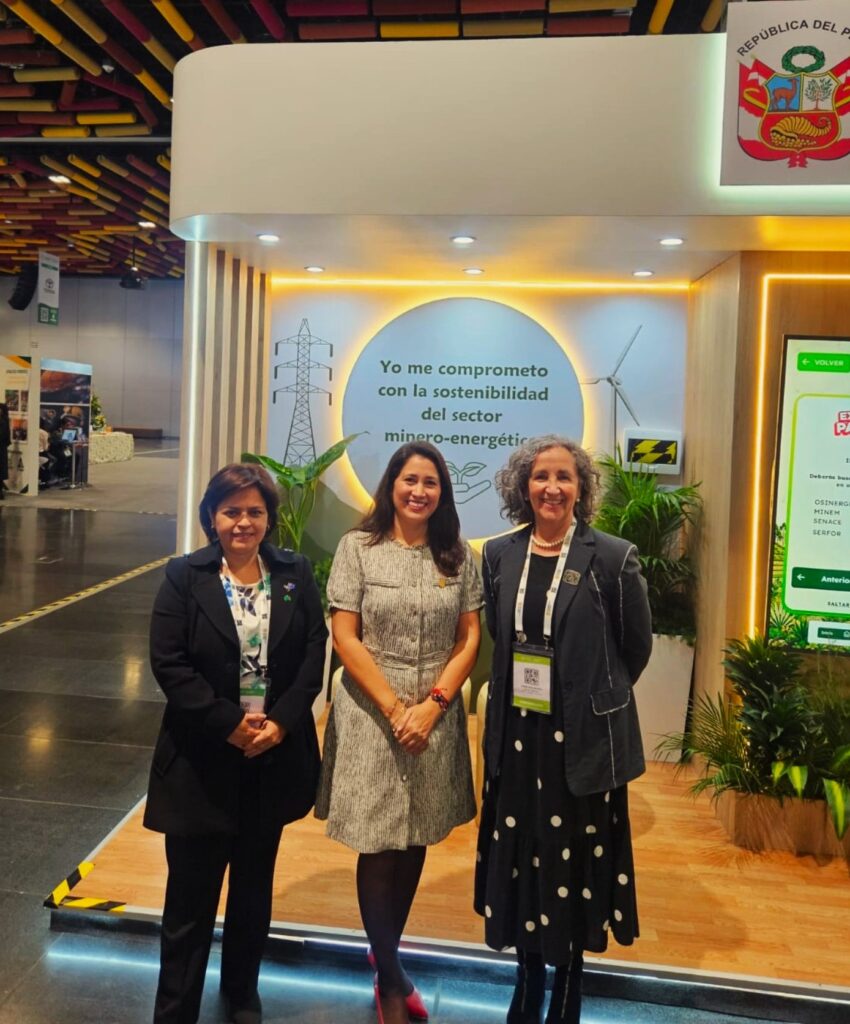
During GESS 2026, Francisca Rivero and Mónica Morales have also held meetings with representatives from industry, academia and government. SMI Chile particularly appreciates the opportunity provided by Mayra Figueroa, Peru’s Vice Minister of Energy and Mines, to share the Centre’s work and discuss opportunities to strengthen collaboration with Peru.
-

- Ivonne Villafana, from TIQ-Peru, Mayra Figueroa, Peru’s Vice Minister of Energy and Mines, and Francisca Rivero, General Manager SMI Chile.
-

- Ivonne Villafana from TIQ-Peru and Pamela Antonioli from the Peruvian Mining Innovation Hub, together with Francisca Rivero and Mónica Morales, from SMI Chile.