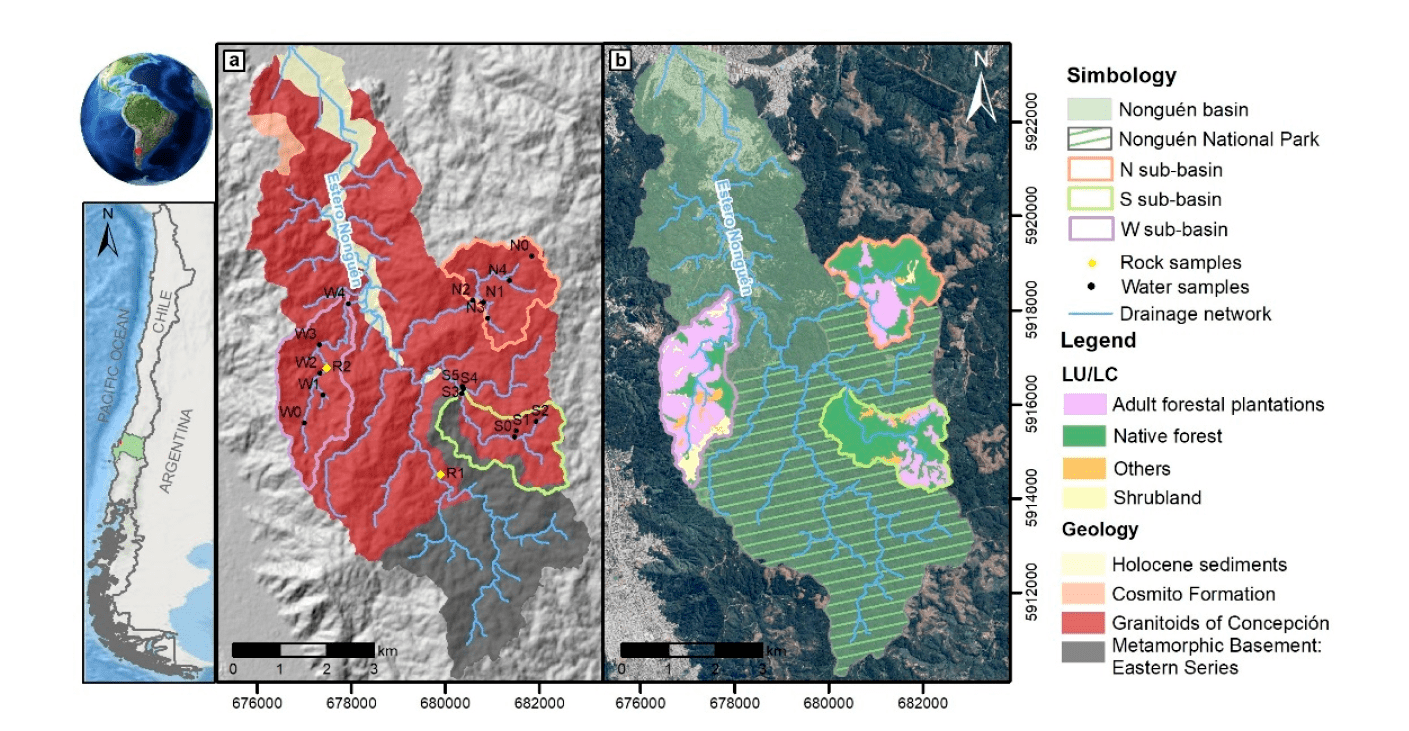
Together with nine colleagues, SMI-ICE-Chile researcher Dilan Campos published an article in the scientific journal Water MDPI entitled: Land-Use Impacts on Soil Erosion: Geochemical Insights from an-Urban Drinking Catchment, South-Central Chile, on the influence of changes in land use on erosion produced on the land surface of the Nonguén basin, in the Bío Bío Region, Chile.
The study provides critical information on how forestry practices, specifically the expansion of exotic plantations, accelerate soil degradation and affect the geochemical composition of river systems.
The research goes deeper into the influence of changes in land use and cover on soil erosion and chemical weathering processes. To do so, a geochemical analysis was carried out with trace elements and lithium (Li) isotopes in river water and sediment samples collected from streams in these sub-basins, with the aim of evaluating how land management practices, particularly planting activities, influence the geochemical composition of river systems.
The results show that elevated concentrations of trace elements – essential for maintaining vital physiological processes – are mainly attributed to increased physical erosion resulting from forestry activities such as clear-cutting and soil disturbance. In sub-basins dominated by plantations, concentrations of elements such as Iron, Aluminum and Arsenic increase ten times more than in sub-basins dominated by native forest. In contrast, sub-basins with native forest cover exhibit lower levels of sediment transport and trace element mobilization, suggesting that native vegetation exerts a stabilizing effect that mitigates soil erosion.
The increased sediment loads, and trace element concentrations observed in plantation-dominated sub-basins raise concerns about the long-term sustainability of forest management practices, particularly with regard to their impacts on water quality in urban catchments. These results are of great relevance for environmental management and policies, as they underline the need for further research and sustainable land use strategies to minimise soil erosion and preserve water resources in regions experiencing rapid changes in land cover and use patterns.
Together with Dilan Campos, the following researchers also participated: Angela Contreras, Fernanda Álvarez-Amado, Maite Aguilar-Gómez, Pamela Castillo, Daniele Tardani, Camila Poblete-González, Joaquín Cortés-Aranda, Linda Godfrey y Nicolás Orellana-Silva.