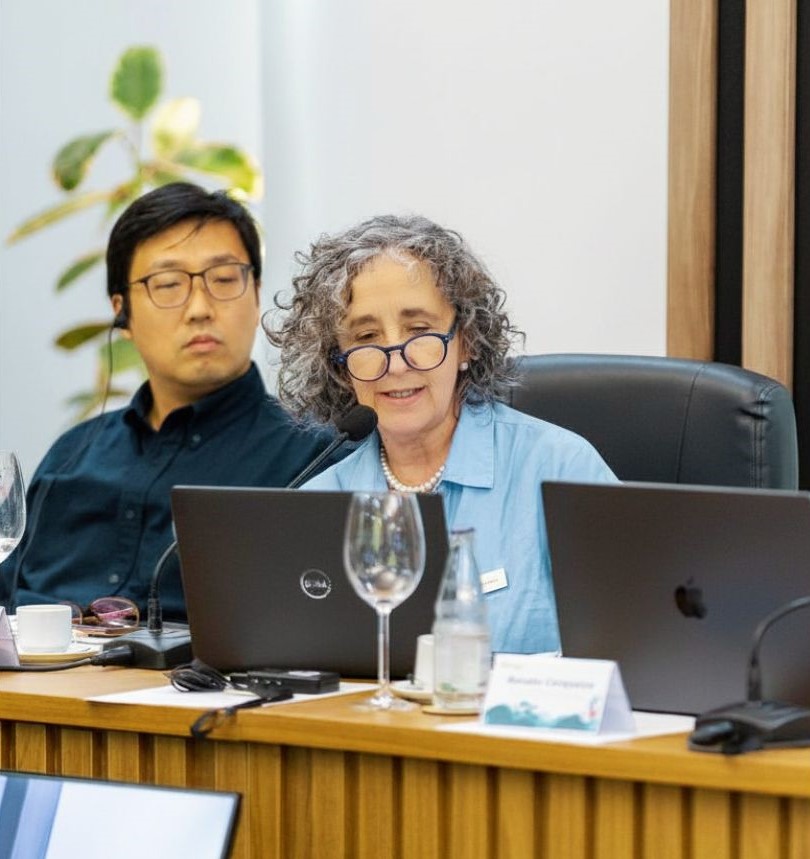
SMI Chile General Manager Francisca Rivero took part as an invited panellist at an international forum that explored the role of the mining sector in a world shaped by technological disruption, geopolitical transitions and the urgent need for decarbonisation.
Carajás Roundtable 2026 was organised by Vale and CEBRI (the Brazilian Center for International Relations).
Held in the Carajás region of the Brazilian Amazon, the event brought together global leaders from the mining and business sectors, government representatives, academics and civil society organisations to discuss how governance, innovation and a renewed social compact can shape responsible mining over the coming decades.
Francisca Rivero joined the panel discussion “The Strategic Role of Critical Minerals in the New Global Geopolitical Order”, alongside Charles Cooper, Research Director at Wood Mackenzie, and Pablo Cesário, Acting President of the Brazilian Mining Association (IBRAM).
Against the backdrop of growing pressure on resource-rich countries such as Chile, Peru and Brazil to expand critical minerals production, the discussion explored the institutional frameworks and partnerships required to ensure that this growth is environmentally sustainable, socially responsible and economically beneficial.
Francisca Rivero argued that the key challenge today is how to increase mineral production without escalating social conflict or environmental degradation.
“In Latin America, the greatest risk to supply security no longer stems solely from resource availability or technological capability, but increasingly from our countries’ ability to build territorial legitimacy,” she said.
She also highlighted a critical challenge: “A significant proportion of these mineral resources is located in environmentally sensitive areas inhabited by Indigenous and rural communities. This means that the global energy transition will depend, to a large extent, on the quality of our governance.”
Francisca referred to a recent comparative analysis of national critical minerals policies in Australia, Chile and Finland, which found that social governance remains the least developed component of these national strategies.
“And this gap has consequences,” she noted. “Today we see technically sound mining projects facing delays, legal challenges or a loss of social legitimacy because communities feel they are consulted too late or that local benefits do not adequately compensate for the impacts they bear.
“That is why we need institutions capable of managing the tensions between economic growth, environmental protection and social development before they escalate into conflict. We must move beyond a permitting approach towards a model of territorial governance. While permits authorise projects, governance builds trust—and trust requires early engagement, transparency and ongoing mechanisms for dialogue, not only during the environmental assessment process.
“For the energy transition to succeed, we need institutions capable of building trust, reducing uncertainty, distributing benefits more equitably and fostering lasting agreements.”
The Carajás Roundtable also included a visit to Vale Amazônia Biopark, an environmental conservation and ecotourism complex maintained by Vale in the Brazilian Amazon.