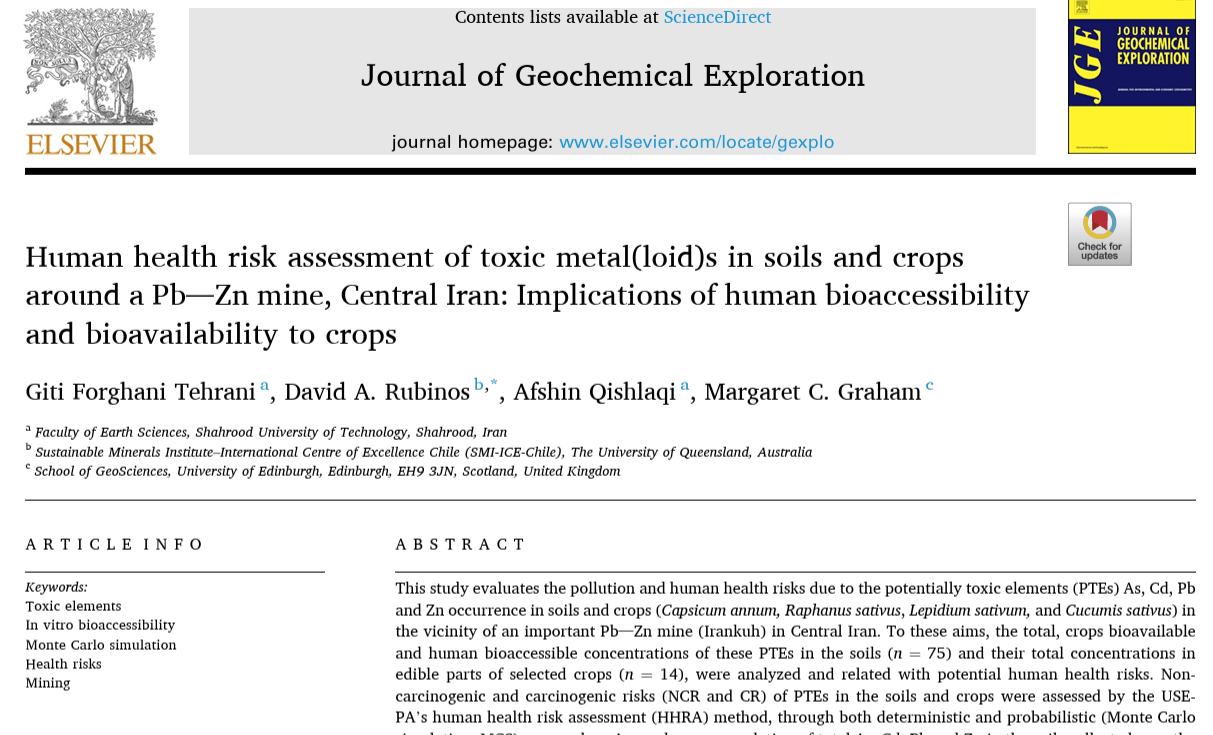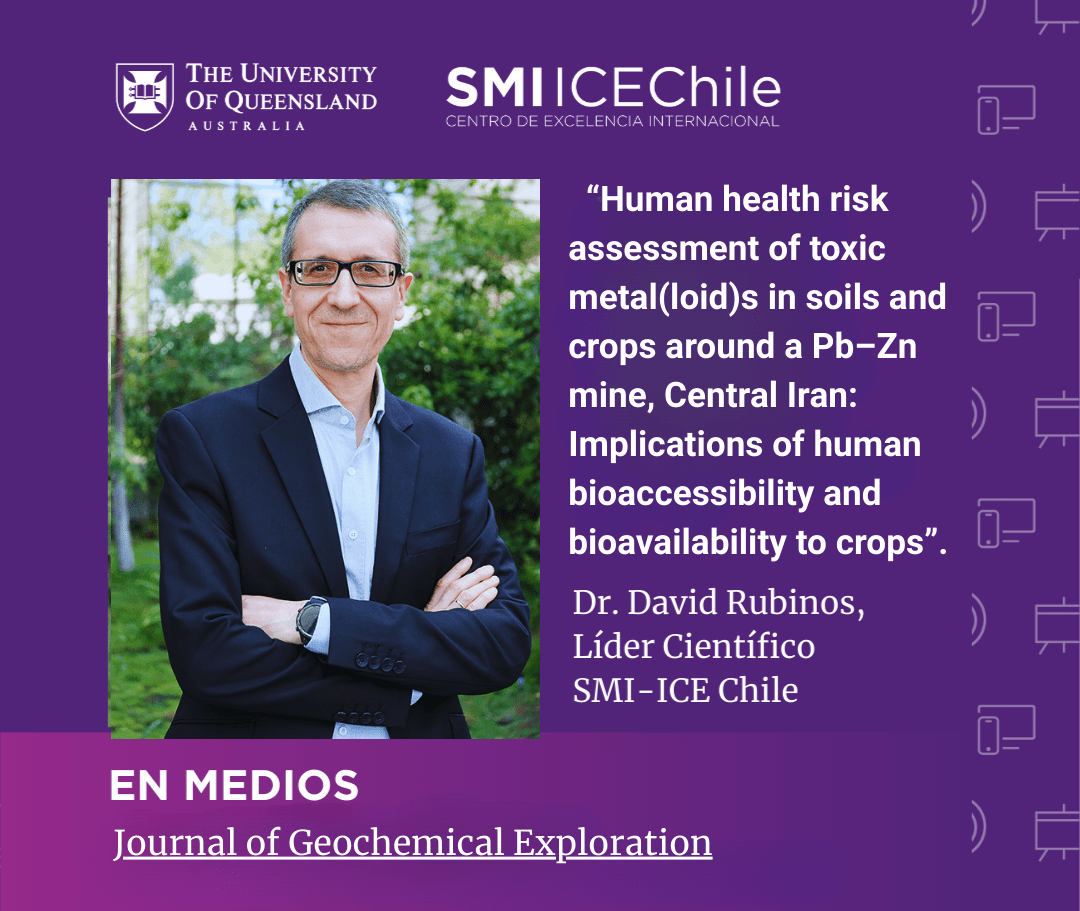
The scientific leader of SMI-ICE-Chile is the author, along with three other researchers, of the paper entitled: «Human health risk assessment of toxic metal(loid)s in soils and crops around a Pb–Zn mine, Central Iran: Implications of human bioaccessibility and bioavailability to crops,» published in the recent issue of the Journal of Geochemical Exploration (Elsevier), a scientific publication that preferentially publishes original studies on exploration and environmental geochemistry.
This scientific article assesses the impacts of a major lead and zinc mine in the Middle East due to contamination of soils and crops with potentially toxic metals and metalloids, in relation to the health risks to people living in the vicinity of this mining operation.
Among the main conclusions, it is noted that the concentrations of toxic metals in soils and crops in the area, especially arsenic and lead, can have detrimental impacts on the health of the local population, with children being at a greater and more worrying risk.
It also notes that, to address the challenges of mining activity in the study area and protect the health of residents, especially children, it is necessary to foster collaboration between the mining company, the government, and local community organizations, implementing soil and waste remediation techniques to reduce the mobility and bioavailability of metals present in the soil, such as installing covers over mining waste, minimizing exposure to contaminated soil and dust through safe gardening practices, and dust control measures.
“The study results emphasize the need to consider, in mining areas, the levels of contaminants that are bioaccessible to humans and bioavailable to crops, in order to obtain a more accurate assessment of potential risks to human health and protect local communities,” explains Dr. David Rubinos.
This publication is the result of a collaboration between Dr. David Rubinos (SMI-ICE-Chile and The University of Queensland), Giti Forghani Tehrani and Afshin Qishlaqi (Shahrood University of Technology), and Margaret C. Graham (School of GeoSciences, University of Edinburgh).
This article can be downloaded at the following link
https://www.sciencedirect.com/science/article/pii/S0375674225001876