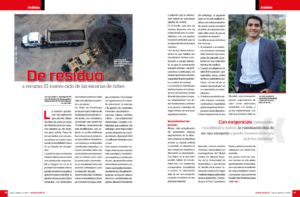
In the March print edition of Revista Minería Chilena, an SMI Chile researcher examines the impact and innovation opportunities arising from the recent regulatory change that now allows the use of copper slag in infrastructure projects.
According to him, one of the key aspects of this regulatory shift is the enabling of mining–construction circularity at a meaningful scale, as the construction sector requires volume, specifications and continuity, while mining provides that volume, as well as processing capacity and material control.
“However,” he explains, “the next step is not only to reuse waste, but to avoid producing it in the first place. Rather than acting once waste already exists, the aim is to generate useful materials before they become waste (…) There are already initiatives moving in this direction, such as the OreSand solution, developed by researchers at the Global Centre for Mineral Security at the University of Queensland, which addresses the ‘sand challenge’ by reducing waste at source through additional processing stages.”
“In this way, we see how new regulations not only open up commercial opportunities, but also raise the standard of responsibility in mining and project a more ambitious circular economy for Chile.”
Download the full article in the following PDF document